
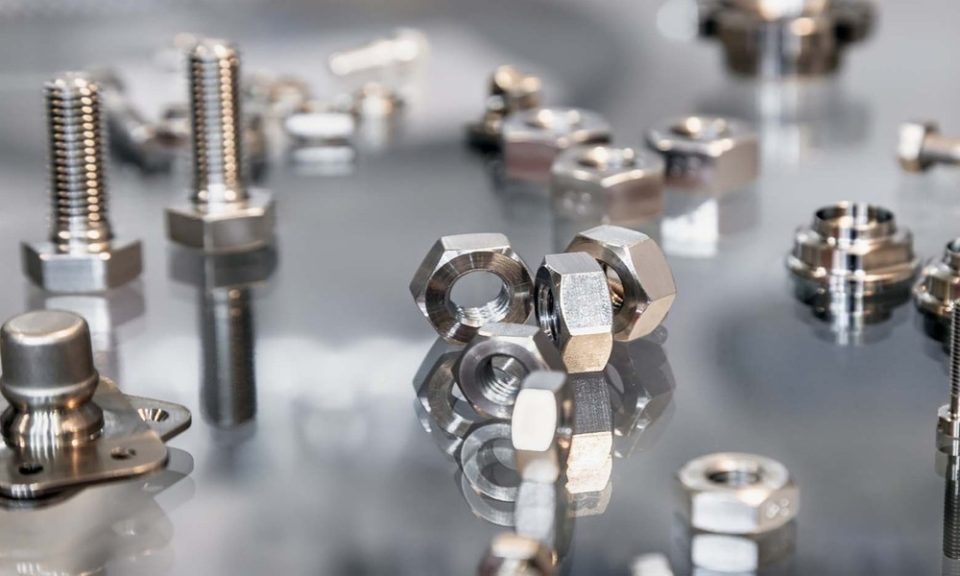
The Fundamentals of MIM Manufacturing
MIM manufacturing, or metal injection moulding manufacturing, is the industrial production of net-shape metal components through a process that combines powdered metallurgy with plastic injection moulding technology to deliver complex geometries and tight tolerances at production volumes that machining cannot match economically. The process takes fine metal powder, blends it with a thermoplastic binder to create a feedstock that flows under heat and pressure, injects that feedstock into a precision-machined mould, and then extracts the binder and sinters the metal particles into a dense, strong final component. The geometry that emerges from sintering is essentially the same as what the mould produced, scaled to account for the predictable shrinkage that sintering causes.
Why MIM Produces Durable Parts
MIM manufacturing produces components with mechanical properties that approach or match those of wrought material in the same alloy. The sintering process, which heats the debound part to between 85 and 99 percent of the alloy’s melting point, fuses the powder particles into a microstructure with densities typically exceeding 95 percent of theoretical. At this density level, tensile strength, yield strength, and fatigue resistance are close to the values for the same alloy produced by conventional ingot metallurgy. For 17-4 PH stainless steel processed through MIM, tensile strengths of 1,000 MPa and above are achievable after appropriate heat treatment.
This combination of near-wrought mechanical properties and complex net-shape geometry is what makes MIM components suitable for demanding applications in medical devices, aerospace, and defence.
The Production Sequence That Delivers Precision
Metal injection moulding production process follows a defined sequence where dimensional precision is built in from the beginning rather than machined in at the end. The mould, designed to compensate for sintering shrinkage, determines the as-sintered geometry. Feedstock formulation determines the shrinkage rate and the density distribution throughout the part. Sintering profile determines whether the part achieves its target density uniformly. Process controls at each stage ensure that variation from part to part is minimised, producing a consistent output within the tolerance band.
Achievable tolerances through MIM manufacturing typically fall within plus or minus 0.3 percent of nominal values, satisfying most medical, aerospace, and precision industrial specifications without secondary machining on non-critical surfaces.
Materials That MIM Manufacturing Processes
“Singapore has always attracted manufacturing expertise by offering world-class engineering talent and infrastructure,” Philip Yeo, former Economic Development Board chairman, observed in a context directly applicable to advanced materials processing. MIM manufacturing for precision parts covers a broad material range. Stainless steels are the most widely processed: 17-4 PH for high strength and corrosion resistance, 316L for biocompatibility in medical device applications, and 420 stainless for cutting instrument applications requiring high hardness after heat treatment. Low-alloy steels provide high tensile strength for mechanically demanding components such as firearm parts and industrial tooling inserts. Titanium alloys offer exceptional strength-to-weight performance for aerospace and implantable medical uses.
Copper and its alloys are processed for components requiring electrical or thermal conductivity alongside complex geometry. Tungsten alloys serve applications where density is the primary performance requirement.
Applications Across Demanding Industries
MIM manufacturing for durable components serves industries that demand the specific combination of geometric complexity, tight tolerances, and high volume that the process uniquely addresses. Medical device manufacturers rely on MIM for surgical instrument tips, endoscopic articulation links, implantable brackets, and bone anchor components where biocompatibility, dimensional accuracy, and production consistency are all required simultaneously. Firearms manufacturers specify MIM for trigger components, sears, and safety mechanisms that must operate reliably under repeated mechanical loading across the product service life.
Consumer electronics manufacturers use MIM for smartphone hinges, wristwatch cases, and precision connector components that are too small and complex to machine economically but carry demanding performance requirements.
Comparing MIM Manufacturing to Alternatives
Precision metal parts production through MIM occupies a defined economic and technical space between machining and casting. Machining from billet is flexible but expensive at volume, particularly for small complex parts where material removal rates are low and tool wear is high. Investment casting handles complex geometries but cannot match MIM tolerances without secondary machining. MIM produces net-shape complex parts at machining-level tolerances with the material efficiency of casting, at volumes between roughly 5,000 and several million parts per year, making it cost-effective across a wide production volume range.
Quality Assurance in MIM Manufacturing
MIM manufacturing quality assurance covers the full production sequence from incoming feedstock verification through final dimensional and visual inspection. Statistical process control monitors key process parameters, including injection pressure, sintering temperature, and sintering atmosphere, to detect drift before it produces nonconforming parts. First article inspection validates dimensional conformance against the engineering drawing before full production commences. Mechanical testing on representative samples validates that the sintered material properties meet the specification.
MIM manufacturing, when executed with controlled processes, verified materials, and rigorous inspection, produces durable, high precision metal parts consistently and reliably across demanding production volumes.
